


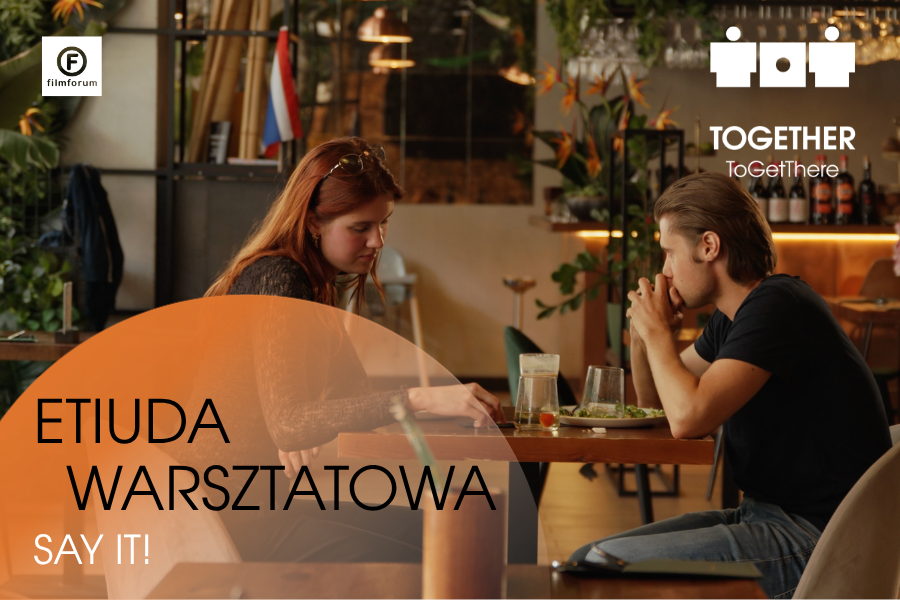
Two people sit opposite each other at a restaurant table. They are close, yet they do not speak. Instead of words, we hear scraping of cutlery against plates, tapping, shuffling feet, and all the small sounds that grow increasingly unbearable by the moment. “Say it!” uses sound to tell a story about something very simple: the need for a conversation.
At first glance, nothing unusual is happening. Two young people are sitting together in a restaurant. They are eating and sharing a table, yet no conversation passes between them.
Under normal circumstances, we likely wouldn’t even notice most of the ambient sounds. In “Say it!”, the opposite is true. The longer the characters remain silent, the more distinct everything between them becomes: the shifting cutlery, the contact of metal against a plate, the movement of legs, the repeated tapping.
The silence brings no calm. It becomes oppressive.
What can be heard when we stop talking?
In “Say it!” sound is not merely a backdrop to the events. It becomes one of the story’s most crucial elements.
The creators use ordinary, inconspicuous sounds to build tension between the characters. Instead of listening to a conversation, the viewer begins to listen to the surroundings that have taken its place.
It is a simple narrative choice, yet it leads to a question far broader than the scene at the restaurant table: what happens between people when they are side by side but cease to truly communicate?
Wouldn’t the conversation sound better?
The film requires neither elaborate dialogue nor complex story. Its meaning is built precisely through their absence.
Small sounds begin to occupy the space that words could fill. What begins as a seemingly ordinary interaction between two people becomes increasingly awkward as the situation unfolds.
“Say It!” is a film created as part of the international TOGETHER project.
Production team: Mariia Irchak, Nicolas Ladino Calvo, Dominik M. Rózsavölgyi, Barnabás Buczkó, Giada Martina D’Arma, Alberto Carruba, Anna Sikora, Yurii Boiko.
Artistic supervision: Karim Kourani.
How would you react if you saw this? “Don’t Smile” – the second film by Karim Kourani’s group
“Don’t Smile” is the second film produced by Karim Kourani’s group. Initially, we see scenes of conflict, focusing solely on the person instigating the argument. However, when the scene is viewed from a wider perspective, we discover that someone else was present the entire time – they saw what was happening, but instead of reacting, they remained a passive observer. The film highlights the responsibility of the bystander and poses a fundamental question: is it enough to notice that something bad is happening? Moral of the film “Don’t just sit there smiling. ACT!” reminds us that sometimes the most important thing is to make a decision to react.
The project is organized by the FILMFORUM Association.
The project is co-financed by the European Union.
Partners: Associazione Cinematografica e Culturale LABORATORIO DEI SOGNI (Italy), Budapest Cultural Center (Hungary), Offener Kanal Magdeburg e.V. (Germany).
The activity is carried out within the framework of The FILMFORUM Group consortium.